Mostrando entradas con la etiqueta novela. Mostrar todas las entradas

viernes, 6 de noviembre de 2020

Un país para el olvido: mi nueva novela corta

El Papel Literario de El Nacional publicó los dos primeros capítulos de mi novela corta Un país para el olvido. Los puedes leer haciendo click aquí

Pueden bajarse la novela completa aquí.

"El cartel decía: «No se acerque a este país. Es mejor que dé la vuelta y se vaya». El gran anuncio era negro. Las letras resaltaban en blanco. Lo volvió a leer. Pensó en retornar a donde había partido y cumplir el mandato del enorme letrero. ¿Sería en serio?"

Un país para el olvido

domingo, 29 de octubre de 2017

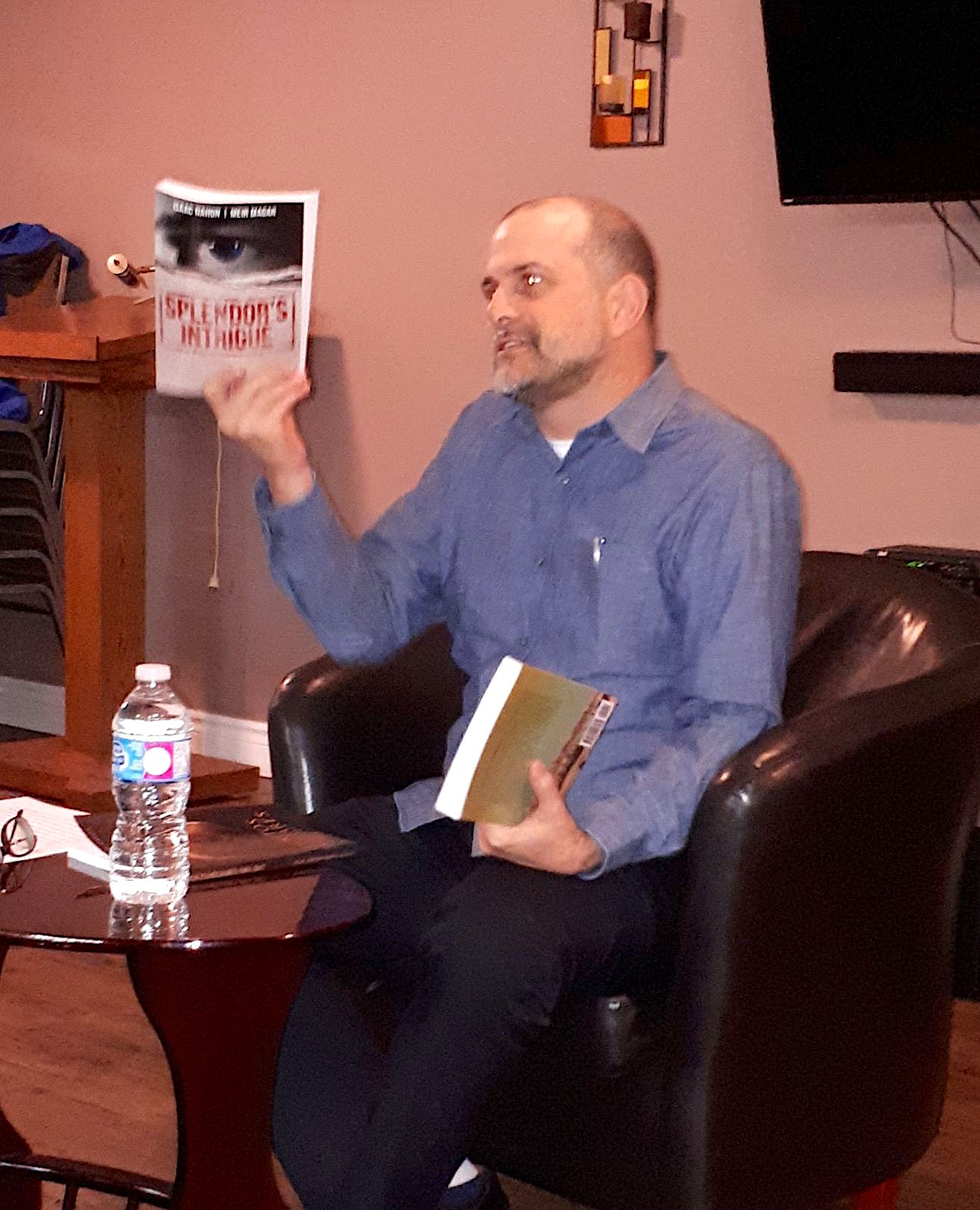
Notes about Splendor's intrigue (English translation of La conjura del esplendor)

Fiction and reality in a very Sephardic novel

Sephardi Association of Ottawa, October 28, 2017
(Motzaé Shabbat)

Shavua Tov, Buenas semanas:

I would like to thank my friends and colleagues from the Sephardi Association of Ottawa, and particularly our president Isabelle Benhamou, for giving me the opportunity to present the English translation of the novel that I co-wrote with Meir Magar, La conjura del esplendor, in English Splendor’s intrigue.

I would also like to thank you all for being here to talk about this very Sephardic novel.

First, I want to briefly discuss the covers of the Spanish and the English versions of the novel, both of them designed by my son Gabriel Nahón. The eye is a common element in both covers, and if you already read the novel, you know that there is this idea that someone, somewhere, has this ability of seeing everything, everywhere and therefore, somewhat a Big Brother who controls things. The main difference between the two covers is the golden hook. In Spanish, it was easy to play with the hook because the word Conjura (Conspiracy or Intrigue) has a “J” in the middle, becoming the glaring hook, a key element in the plot of the novel. Without spoiling the story for those who have not read it yet, this novel has at least three narrative layers, and one of the layers (the novel within the novel) is actually a hook to catch certain “fishes” blinded by the light or the splendour of the story.

What means to write a novel with another person, writing by four hands, as we sometimes do when playing piano? Meir lives in Venezuela, and I live here in Ottawa. Today we have Whatsapp, email, Google, Skype. But even with all this technology, the main challenge of writing a text with another person is not the exchange of information or sharing ideas. The main challenge is how you build a story or various stories (as in the case of this novel) that at the end will have some internal coherence and cohesiveness, and will, hopefully, capture the attention of the reader. 

As everything in life, the novel Splendor’s intrigue has a genesis. The origin of the novel is a research that Meir Magar did about the story of the Nahón family. He did a very comprehensive research, read many documents, consulted several Internet sites. The Nahón’s family story is in many ways the story of the Sephardim expelled from Spain in 1492.  Meir first wrote a paper that he published in the journal of Sephardic Studies Maguén-Escudo in Caracas. But Meir had a lot of information. He called me one day and told me. I have very interesting details about the Sephardim. I think I can write a novel with this. Would you like to write it with me?

I was not sure what was going to result from this experiment. Meir took care of everything that is either historical, old or mythical in Splendor’s intrigue. I focused on the contemporary fiction. The question was how we could connect both narrative streams, the old, historical, and the current fictional events. What could be the link between the saga of the descendants of the great Sephardi poet Yehuda Ha’Levi Abulafia, and the plot of delirious and apocalyptic religious fanatics in this turbulent world?  

The writing process was a truly contrapunctus as we say in music, a contrapunteo as we say in Venezuela. Sometimes the contrapunctus was quite intense: to a historical chapter from Meir, followed another one of current conspiracies, celestial hackers and the almost detective work done by some of the characters in the novel.

But we faced moments where nothing worked and the contrapunctus stopped. At this time, in front of the “white page”, a conversation via Skype with Meir helped to ignite the spark of imagination and to find an exit to the labyrinth that we were building together.

Why did we decide to call the novel Splendor’s intrigue or La conjura del esplendor? My colleague Pierre Lévy told me that the idea of conspiracy or intrigue is associated with the notion of opacity, something that is hidden. Why then make the connection with this notion of light, something that is brilliant, flashy? It’s because at the heart of the intrigue, of the plot, there is an object that causes a glare, an effect of blinding by the excess of light (éblouissement in French). And the story of this glaring object that could seem fantastic, impossible, could be seen as real, truthful in the eyes of some delirious fanatics. And who is weaving this web of intrigues? Someone who knows well the psychology of these fundamentalists who are ready to believe in their own toxic conspiracy theories.

The labyrinth that we built in this novel was carefully set by my co-writer Meir Magar. All the events in the novel before and after the expulsion of the Jews from Spain in 1492 are very well documented. In the notes from the “writer” Haim Abulafia, the doctor from Tel Aviv who descends from the family of Yehuda Ha’Leví Abulafia, that you can find at the end of the novel have the references with the books, the sources, the sites that we consulted. We tell there the story of the Jews from Spain, with its splendorous and not so splendorous moments. But I think the value of this novel, and this is my very subjective opinion, resides in approaching the question of being Sephardi, of being a Sephardic Jew in the current context, and explores, in a fictional but still valid way, how what happened in the past shapes the current geopolitical moment when identities emerge, change, are strengthened (as in the case of the “marrano” or “converso” Segura in the novel), but also how they coexist and enter in conflict.  

And this leads me to my other question: how history, fiction and current events are articulated in this novel? I think the main difference with the history of historians, that should be very rigorous, the historical novel or historical fiction can introduce some nuances, some grey areas that are also important to understand what we are living now. In that sense, I would like to highlight something about the characters of Splendor’s intrigue: they are all very human in their greatness or miseries, in their idealism or in their very basic instincts. And sometimes, those who are portrayed as villains in the media, could also have their heroic side, and vice versa, there are heroes that can become villains. In the labyrinth of the novel we find a cul-de-sac.  What’s the right path towards the exit of this labyrinth? I don’t think we have a clear, definitive answer from the perspective of the historical fiction. And I am wondering if we, Meir and I, found really the right path to escape from the Splendor’s intrigue. I will leave it to the readers to answer this question. Some readers have told us that they feel that the novel continues and are looking forward to read the second part. Let’s see what happens.

Thank you,


Isaac Nahón Serfaty

domingo, 19 de febrero de 2017

Reflexiones sobre La conjura del esplendor

Palabras de Isaac Nahón durante la presentación de La conjura del esplendor en la Universidad de Ottawa el pasado 16 de febrero, 2017.


Quiero antes que nada agradecer a mis colegas Luis Abanto Rojas y Jorge Carlos Guerrero por haberme dado la oportunidad de presentar la novela que coescribí con Meir Magar, La conjura del esplendor, aquí en la Universidad de Ottawa.

Quiero también agradecer a todos los presentes por acompañarme en esta ocasión a pesar de las inclemencias del invierno.

Quiero dedicar esta presentación a la memoria de mi amigo y colega Mahmoud Eid, profesor en el Departamento de comunicación. I would like to dedicate this presentation to the memory of my friend and colleague Mahmoud Eid, in the spirit of openness and appreciation of diversity that guided our collaborations in intercultural and international communication. Descansa en paz, querido amigo.

La presentación estará dividida en cuatro partes: 1. ¿Cuáles son los retos de escribir una novela a cuatro manos?; 2. ¿Por qué el título y por qué esta portada?; 3. ¿Qué sentido tiene contar hoy en día la historia de los sefardíes en el contexto de este mundo convulso?; 4. ¿Cuál es la relación entre ficción, historia y actualidad?

Primero, quiero compartir mis impresiones sobre la experiencia de escribir una novela a cuatro manos, especialmente cuando median cuatro mil kilómetros de distancia entre los dos autores. Claro que hoy en día tenemos Whatsapp, Skype, correo electrónico, Google. Sin embargo, a pesar de toda la tecnología, el reto de la escritura a dos no es tanto cómo intercambiar información, textos, sino cómo ir generando una historia, o varias historias (como es el caso en esta novela), que resulten más o menos coherentes, y que puedan capturar el interés del lector.

Como todo en la vida, La conjura del esplendor tiene un origen, y este origen se debe a una investigación que Meir empezó sobre los Nahón. Él una investigación muy completa, leyó muchos documentos y, por supuesto, la historia de los Nahón es la de los sefardíes expulsados de España. El resultado de esa investigación se convirtió en un artículo que Meir publicó en la revista Maguén-Escudo del Centro de Estudios Sefardíes de Caracas. Pero Meir tenía muchísimo material que había recopilado. Un día me llamó y me dijo: aquí tengo un montón de información interesante sobre los sefardíes, y se me ocurre que podría escribir una novela con esto. ¿Quieres que escribamos la novela juntos?

La verdad que no estaba seguro qué podría salir de este experimento. Meir se ocupó de todo lo que es histórico o antiguo en La conjura del esplendor. Yo me concentré en lo que es actual, o al menos en lo que nos habla del mundo de hoy. El reto era cómo conectábamos esos dos ejes narrativos. ¿Qué podía unir la saga de los descendientes del gran poeta Yehudá Ha’Leví Abulafia con una trama de delirios apocalípticos de fanáticos religiosos tan propia de este convulso mundo de hoy en día?

El proceso de escritura fue un contrapunteo, como se dice en el llano venezolano, a veces bastante intenso, pues a un capítulo histórico o antiguo de Meir, le seguía otro mío anclado en la actualidad de las conspiraciones, los hackers y un trabajo casi detectivesco que hacen algunos de los personajes de la novela.

Pero hubo momentos en que el juego se trancó, y el contrapunteo no salía tan fluido. Más que escribir, en esos momentos de “páginas en blanco”, especialmente para mí, una conversación por Skype con Meir ayudaba a encender la chispa de la imaginación y a encontrar la salida del laberinto que habíamos construido.

Ahora bien, ¿por qué llamamos la novela La conjura del esplendor y por qué la portada tiene un ojo y un anzuelo? (portada que por cierto diseño mi hijo Gabriel, quien hizo un gran trabajo). El otro día conversando con mi colega Pierre Lévy, me hizo la siguiente observación: la idea de conjura, de conspiración, refiere normalmente a la opacidad. ¿Por qué entonces llamarla La conjura del esplendor? Justamente porque la clave está en el brillo de un objeto que deslumbra y que está en el centro de la conjura, y en el deslumbramiento (éblouissement en francés) que puede producir en fanáticos delirantes un relato, una historia que puede parecer fantástica, imposible, pero que para ellos resulta, dentro de su locura, totalmente verosímil. ¿Y quién arma esta conjura? Pues alguien que lo ve todo, representado por el ojo omnipresente, que tiene acceso a la información y a la psicología de estos delirantes, y por eso lanza un anzuelo resplandeciente con la carnada de la conjura para atrapar a estos fanáticos dispuestos a creer su propia intoxicación conspirativa.

Tercero, el laberinto que armamos a cuatro manos en la conjura tiene una base que mi coautor, Meir Magar, fue construyendo con mucho cuidado. Todo lo que se refiere en La conjura del esplendor a la historia de los sefardíes antes y después de la expulsión de España en 1492 está bien documentado. En las notas del “escritor” de la novela dentro de la novela, el Doctor Hayim Abulafia (descendiente del gran poeta Yehudá Ha’Leví Abulafia), cardiólogo de Tel Aviv, están todas las referencias que documentan esa historia de momentos esplendorosos y momentos terribles que vivieron los judíos en España. Pero creo que el valor de la novela, y claro es una opinión muy subjetiva de una parte interesada, reside en plantear el tema del sefardismo, del ser judío sefardí, en el contexto actual, y explorar, dese la ficción, cómo lo que ocurrió en un pasado remoto adquiere sentido en el momento geopolítico actual en el que identidades surgen, cambian, se consolidan, se enfrentan y también conviven.

Y esto justamente me lleva al cuarto punto de esta presentación. ¿Cómo se articulan historia, ficción y actualidad en la novela? Creo que, a diferencia de la historia de los historiadores, que tiene una rigurosidad científica necesaria, la historia novelada o la historia ficción nos permite presentar unos matices, unos grises que resultan importantes para comprender lo que estamos viviendo en la actualidad. Quiero, en ese sentido, destacar algo de los personajes de La conjura del esplendor: son personajes muy humanos con sus glorias y sus miserias, con sus idealismos y sus impulsos más básicos. Y a veces, los que son comúnmente presentados por los medios de comunicación como los villanos, también tienen un lado heroico, y viceversa, hay héroes que en ocasiones pueden resultar villanos. Y en este laberinto que es la novela, a veces nos metemos en caminos llenos de bifurcaciones. ¿Cuál es el buen camino? ¿Quién es el bueno o el malo? No siempre la respuesta es obvia, al menos desde el punto de vista de la historia ficción.

Me pregunto, sin embargo, ¿si de verdad encontramos la salida de ese laberinto que se llama La conjura del esplendor? No lo sé. Queda a los lectores juzgar si hay una salida o si quedan atrapados en los acertijos de La conjura del esplendor. Lo que algunos lectores ya nos han dicho es que sienten que la conjura continúa y esperan descubrir cómo sigue en la próxima novela.


Muchas gracias.