Mostrando entradas con la etiqueta Iran. Mostrar todas las entradas

sábado, 3 de agosto de 2024

Pourquoi le Venezuela est important d’un point de vue géopolitique


Pour mes amis francophones, j'explique le contexte géopolitique de la fraude dans les élections présidentielles au Vénézuéla dans cet article dans le Le Devoir de Montréal: Cliquez ici

hashVenezuela dans @LeDevoir de

domingo, 10 de mayo de 2020

Foucault y la fascinación de la izquierda radical por la República islámica de Irán


“En sus crónicas sobre el Irán revolucionario, el filósofo francés Michel Foucault (1978) observó con entusiasmo la “espiritualización de la política” del movimiento que lideraba el Ayatolá Jomeini”

El artículo completo en El Papel Literario de El Nacional.

domingo, 5 de enero de 2020

Realidad y ficción: un agente iraní en La Conjura del Esplendor

La novela se mezcla con la actualidad

A veces la realidad y la ficción se confunden. En 2016 Meyer Magarici (Meir Magar) e Isaac Nahon publicamos La Conjura del Esplendor, una novela que escribimos a cuatro manos. En el texto se mezclan la historia, la fantasía y la conspiración internacional, con espías y agentes de servicios secretos y milicias. Un personaje de la novela es el iraní Daud Mohadesh, miembro de la Fuerza Quds, como lo era el recientemente asesinado Soleimani. Aquí pueden leer un capítulo donde aparece el iraní:

LA OSCURIDAD QUE ALUMBRA

Daud Mohadesh vio la luna que brillaba alta y redonda sobre el Valle de la Becá. Como se creía poeta, hilvanó unos versos en su lengua materna - el farsi - sobre el resplandor de la oscuridad. Sabía que esa luz no venía del astro que marcaba su calendario, sino del Creador del Universo, el Más Grande, Alá el Misericordioso. Estaba lejos de casa, pero la luna era la misma, y la lucha también.
Acarició el AK47 que tenía sobre las piernas. Se percató que era de un negro brillante bajo el influjo de la misteriosa dama de la noche. Empezó a tararear una melodía de una canción que escuchó en sus tiempos de estudiante en Oxford: “I’ve been followed by a moon shadow, moon shadow, moon shadow…”. La cantaba Cat Stevens, un artista pop que bebió en la fuente de la Verdad y reconoció que no hay otro Dios que Alá y Mahoma es su enviado. Ahora se llama Yusuf Islam.
Había llegado al Líbano hacía un par de años. Su misión era servir de liaison con Hezbolá. Tenía ambiciones. Sin embargo, era un obediente servidor del Ayatolá Imranei. Siguiendo las enseñanzas de su Maestro entendía que la misión iba más allá del país de los cedros. Al sur estaba ese “cáncer sionista”, el pequeño Satán.
- No seas impaciente, Daud. El tiempo de Alá es perfecto. Yo te diré cuándo es el momento propicio para actuar – le dijo el Ayatolá Imranei cuando le asignó la misión con el Ejército de Dios.
Daud sentía un cosquilleo, un frenesí cuando rumiaba su furia sagrada. Recitaba enseguida un verso del Corán para recobrar la necesaria compostura propia de un soldado de Alá: “Creyentes; Combatid contra los infieles que tengáis cerca. Que os encuentren duros. Sabed que Dios está con los que Le temen”. Su mente podía ir lejos, imaginarse grandes proezas, batallas, sacrificios, martirologios. No era, sin embargo, él quien decidía. Su jefe directo era Nasrallah, Imam y Comandante Supremo de Hezbolá. La estrategia ahora - le había explicado - era enfocarse en el frente sirio donde seguía actuando el Estado Islámico, el otro enemigo. Al “cáncer sionista” lo mantendrían a raya.
- Los judíos aprendieron su lección después de la última guerra. Saben que el precio que pagarán si nos invaden será alto – razonaba Nasrallah-. Daud, tu ayuda es muy apreciada por nuestros hermanos sirios. Ese debe ser tu foco.
El persa – así lo llamaban los combatientes libaneses – veía las cosas de otra manera. La liberación de Palestina cambiaría todo el cuadro de la región. La conquista de Al Quds (Jerusalén le dicen los infieles) daría un giro de 180 grados a la situación. Su plan no era el producto de una mente afiebrada. Había estudiado historia del Medio Oriente en Oxford. Conocía al dedillo las guerras, los triunfos y las derrotas de los musulmanes. Admiraba a Salah ad-Din (Saladín) el Sultán. Despreciaba a quienes embrutecieron a los creyentes, los mantuvieron pobres e ignorantes, y se aliaron con los colonialistas. Y después llegó el sionismo, la punta de lanza de Occidente para acabar con el Islam. Los judíos se victimizaron, manipularon la historia de la Segunda Guerra Mundial, usaron su poder financiero y mediático, y convencieron a los imperios para que los apoyaran en su vicioso plan de control del Medio Oriente.
Hizo un rápido cálculo mental. Palestina estaría apenas a 60 kilómetros desde donde estaba sentado, menos de una hora en automóvil. La noche era clara. Era el mismo cielo, las mismas estrellas que cubrían ese todo que debería ser una Unidad Perfecta, el Dar al Salam, la Casa de la Paz. No se hacía ilusiones, no pensaba que los creyentes comunes y corrientes estarían dispuestos a hacer lo necesario para lograr extirpar ese cáncer. Como buen chií estaba convencido que esta será la misión del Majdi, el redentor del islam que reinará antes del Día del Juicio Final.
Volvió a mirar la luna que destellaba en el cielo oscuro. Su vena poética le sacó de los labios unos versos sobre la Noche de la Redención, del Majdi que permanece escondido en esa oscuridad luminosa antes de revelarse al mundo. “¡Ya está entre nosotros, pero nosotros no lo merecemos…! ¡Oh creyentes! ¡Vuestros méritos traerán la luz del Majdi…! ¡Oh creyentes! Póstrense ante Alá, el Más Grande, quien removerá el velo que tapa vuestros ojos para que veáis a su enviado, la paz sea con él…”. Los versos incrementaron el cosquilleo, su frenesí. Estuvo tentado de apretar el gatillo y disparar al aire, pero no quiso perturbar a quienes todavía dormían en la casa de adobe. Pronto el mu'aḏḏin llamaría a la plegaria de la mañana.

La novela está disponible en Amazon.

viernes, 22 de febrero de 2019

Aprendiendo a leer: sobre titulares tendenciosos en medios “equilibrados”


Por deformación profesional, siempre tengo la inclinación a interpretar. No se trata de buscarle las cinco patas al gato (mis adorados gatos), pero de darle sentido a la palabra. El otro día comenté un titular de El País, en su edición América, que afirmaba que la intervención de Trump en la crisis venezolana opacaba el papel de las fuerzas democráticas. Mi comentario me valió una reprimenda de un colega que me llamó miope y prejuicioso.

Ningún discurso es inocente. Todo discurso es enunciado por una persona con una visión del mundo (incluso, éste que escribo ahora). Cuando editores y periodistas tratan, a estas alturas, de presentar alguna equivalencia entre la lucha de las fuerzas democráticas por la libertad y el empecinamiento de Maduro y sus secuaces por quedarse en el poder usurpador, se equivocan periodísticamente y moralmente. Peor aún, cuando pretenden reducir esta lucha a una manipulación del imperialismo yanqui para desalojar a Maduro de Miraflores, simplemente repiten una serie de viejos estereotipos y lugares comunes.

¿Que el imperialismo existe? Pues sí. ¿Que el gobierno que encabeza Trump está haciendo todo lo posible por acabar con el régimen criminal que tiene secuestrado a Venezuela? Obvio. ¿Que para ello se ha puesto en marcha una estrategia coordinada entre actores nacionales e internacionales, lo que incluye a muchos otros países como Canadá, Colombia, Brasil, etc.? Clarísimo.

¿Qué motiva este tipo de titulares? Tengo algunas hipótesis, pero avanzo la que me parece más plausible. Algunos editores y periodistas de medios tan prestigiosos como la BBC, El País o The Guardian (que han denunciado desde hace mucho tiempo los abusos, corruptelas, violaciones, barbaridades y miserias del chavismo, porque todo hay que decirlo), a veces se dejan llevar por un impulso de supuesta objetividad para poner sobre el tapete que la intervención del “antipático” Trump y funcionarios como Bolton y Abrahams (con sus pasados “problemáticos”) representa de alguna forma la tradicional política del gran garrote de EE.UU.

Los venezolanos sabemos que no es exactamente así. Estados Unidos tiene intereses en el hemisferio (de nuevo, lo obvio). Pero el tipo de régimen que estamos enfrentando, que cuenta con aliados como la Cuba castrista (el vampiro del Caribe), Rusia (que está a punto de hacerse la sueca), China (que quiere que le paguen sus reales), Irán (que odia al Gran Satán y al Pequeño Satán = Israel), Hezbolá (que ya tiene un record de muerte en Latinoamérica, por su participación en los atentados de Buenos Aires), y toda clase de criminales (desde tratantes de blancas hasta el ELN), no sale solamente con la presión interna. Desde adentro y desde afuera hay que hacer peso para que caiga, y que podamos tener un gobierno de transición y elecciones libres.

domingo, 29 de octubre de 2017

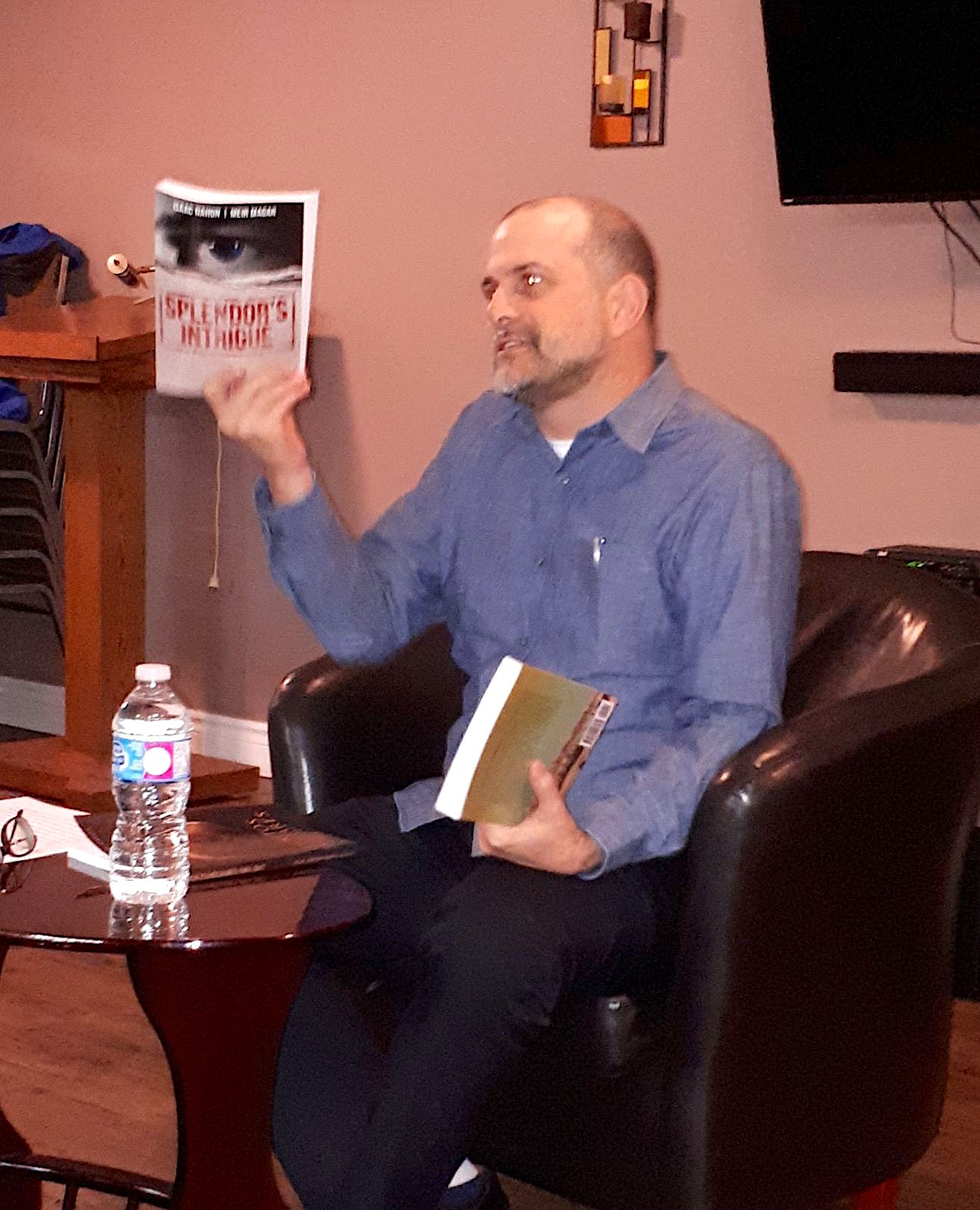
Notes about Splendor's intrigue (English translation of La conjura del esplendor)

Fiction and reality in a very Sephardic novel

Sephardi Association of Ottawa, October 28, 2017
(Motzaé Shabbat)

Shavua Tov, Buenas semanas:

I would like to thank my friends and colleagues from the Sephardi Association of Ottawa, and particularly our president Isabelle Benhamou, for giving me the opportunity to present the English translation of the novel that I co-wrote with Meir Magar, La conjura del esplendor, in English Splendor’s intrigue.

I would also like to thank you all for being here to talk about this very Sephardic novel.

First, I want to briefly discuss the covers of the Spanish and the English versions of the novel, both of them designed by my son Gabriel Nahón. The eye is a common element in both covers, and if you already read the novel, you know that there is this idea that someone, somewhere, has this ability of seeing everything, everywhere and therefore, somewhat a Big Brother who controls things. The main difference between the two covers is the golden hook. In Spanish, it was easy to play with the hook because the word Conjura (Conspiracy or Intrigue) has a “J” in the middle, becoming the glaring hook, a key element in the plot of the novel. Without spoiling the story for those who have not read it yet, this novel has at least three narrative layers, and one of the layers (the novel within the novel) is actually a hook to catch certain “fishes” blinded by the light or the splendour of the story.

What means to write a novel with another person, writing by four hands, as we sometimes do when playing piano? Meir lives in Venezuela, and I live here in Ottawa. Today we have Whatsapp, email, Google, Skype. But even with all this technology, the main challenge of writing a text with another person is not the exchange of information or sharing ideas. The main challenge is how you build a story or various stories (as in the case of this novel) that at the end will have some internal coherence and cohesiveness, and will, hopefully, capture the attention of the reader. 

As everything in life, the novel Splendor’s intrigue has a genesis. The origin of the novel is a research that Meir Magar did about the story of the Nahón family. He did a very comprehensive research, read many documents, consulted several Internet sites. The Nahón’s family story is in many ways the story of the Sephardim expelled from Spain in 1492.  Meir first wrote a paper that he published in the journal of Sephardic Studies Maguén-Escudo in Caracas. But Meir had a lot of information. He called me one day and told me. I have very interesting details about the Sephardim. I think I can write a novel with this. Would you like to write it with me?

I was not sure what was going to result from this experiment. Meir took care of everything that is either historical, old or mythical in Splendor’s intrigue. I focused on the contemporary fiction. The question was how we could connect both narrative streams, the old, historical, and the current fictional events. What could be the link between the saga of the descendants of the great Sephardi poet Yehuda Ha’Levi Abulafia, and the plot of delirious and apocalyptic religious fanatics in this turbulent world?  

The writing process was a truly contrapunctus as we say in music, a contrapunteo as we say in Venezuela. Sometimes the contrapunctus was quite intense: to a historical chapter from Meir, followed another one of current conspiracies, celestial hackers and the almost detective work done by some of the characters in the novel.

But we faced moments where nothing worked and the contrapunctus stopped. At this time, in front of the “white page”, a conversation via Skype with Meir helped to ignite the spark of imagination and to find an exit to the labyrinth that we were building together.

Why did we decide to call the novel Splendor’s intrigue or La conjura del esplendor? My colleague Pierre Lévy told me that the idea of conspiracy or intrigue is associated with the notion of opacity, something that is hidden. Why then make the connection with this notion of light, something that is brilliant, flashy? It’s because at the heart of the intrigue, of the plot, there is an object that causes a glare, an effect of blinding by the excess of light (éblouissement in French). And the story of this glaring object that could seem fantastic, impossible, could be seen as real, truthful in the eyes of some delirious fanatics. And who is weaving this web of intrigues? Someone who knows well the psychology of these fundamentalists who are ready to believe in their own toxic conspiracy theories.

The labyrinth that we built in this novel was carefully set by my co-writer Meir Magar. All the events in the novel before and after the expulsion of the Jews from Spain in 1492 are very well documented. In the notes from the “writer” Haim Abulafia, the doctor from Tel Aviv who descends from the family of Yehuda Ha’Leví Abulafia, that you can find at the end of the novel have the references with the books, the sources, the sites that we consulted. We tell there the story of the Jews from Spain, with its splendorous and not so splendorous moments. But I think the value of this novel, and this is my very subjective opinion, resides in approaching the question of being Sephardi, of being a Sephardic Jew in the current context, and explores, in a fictional but still valid way, how what happened in the past shapes the current geopolitical moment when identities emerge, change, are strengthened (as in the case of the “marrano” or “converso” Segura in the novel), but also how they coexist and enter in conflict.  

And this leads me to my other question: how history, fiction and current events are articulated in this novel? I think the main difference with the history of historians, that should be very rigorous, the historical novel or historical fiction can introduce some nuances, some grey areas that are also important to understand what we are living now. In that sense, I would like to highlight something about the characters of Splendor’s intrigue: they are all very human in their greatness or miseries, in their idealism or in their very basic instincts. And sometimes, those who are portrayed as villains in the media, could also have their heroic side, and vice versa, there are heroes that can become villains. In the labyrinth of the novel we find a cul-de-sac.  What’s the right path towards the exit of this labyrinth? I don’t think we have a clear, definitive answer from the perspective of the historical fiction. And I am wondering if we, Meir and I, found really the right path to escape from the Splendor’s intrigue. I will leave it to the readers to answer this question. Some readers have told us that they feel that the novel continues and are looking forward to read the second part. Let’s see what happens.

Thank you,


Isaac Nahón Serfaty