miércoles, 21 de marzo de 2018

Why Linda McQuaig is so wrong about Venezuela?


The article of Linda McQuaig about Venezuela is so wrong in so many ways. First, she distorts the facts to portray the Venezuelan tragedy as "a bitter class war, with millions of poor people committed to defending a revolution carried out in their name."  Second, she took sides to defend a corrupt and criminal regime, repeating the hollow rhetoric of Nicolás Maduro and his cronies about the "economic war against a nation" that does not exist. Actually, the only war is the one that the regime of Nicolas Maduro is waging against his own people.

But Linda McQuaig suffers from ideological blindness. She cannot see what is happening in Venezuela because she bought the arguments of Maduro to justify his wrongdoings. She forgot to mention that the policies of the Maduro regime - following the same populist prescriptions instituted by Hugo Chávez - have caused the free fall of the economy: deep recession in the last four years (minus 10 GDP this year), hyperinflation rising to three digits (expected to rise to 14,000 percent this year), maxi devaluation of the currency, and the destruction of the national oil company PDVSA.

She cannot see either that Venezuelans are living a truly humanitarian crisis. Hunger is a real problem. Malnutrition among the poor, particularly children, has been widely documented. Venezuelans are also dying or suffering because they don't have access to medication and basic medical services.

Linda McQuaig is blind to the reality that Venezuelans live under a violent and cruel regime. During four months of protests the Maduro regime murdered more than 100 people. Or that there are still almost 300 political prisoners, many of them civilians submitted, illegally, to trials in military courts. She did not say that the political police of the government, Sebin, does not comply with judges ordering the release of prisoners and extorts them and their families, asking for large sums of money in US dollars to "buy" their freedom. Or that the poor are enslaved through the CLAP system, a perverse program of social control through the distribution of food bags. She forgot to say that crime is out of control. More than 20 thousand people are murdered each year. Prisons have become the paradise of criminals, under the control of gang leaders, thanks to the complicity of government officials.

Linda McQuaig is so wrong about Venezuela that she does not know the history of the country. Chávez did not nationalize the oil industry, as she wrongfully wrote. The oil industry was nationalized in 1976 during the first government of Carlos Andrés Pérez. Nevertheless, this should be a "minor" detail for someone who dares to defend a regime that is the source of suffering and horror for millions of Venezuelans.

domingo, 18 de marzo de 2018

Being a Sephardi Moroccan Venezuelan Canadian Jew: A case of multiple identities


Everybody is obsessed with identity these days. People look deeper to find their roots. They have their DNAs checked by ancestry.com or geni.com to find out their genetics mix (because we are all the result of a mix –there is no “racial” purity fortunately – but we – the humanity - seem to come from the same parents, as shown by a recent study published in Science journal). There is identity politics and its subdivisions: gender, religious, language politics. Certainly we, Jews, have been obsessed with our identity, either from within but mainly from outside, particularly when those who wanted to destroy us had a supposedly “clear” answer to the question “Who is a Jew?” I won’t try to answer this question – I prefer to leave it as an open question -. Instead I propose to explore the multiples dimensions of identity, and I will try to do so with the case I think I know the better, my own case as a Sephardi Moroccan Venezuelan Canadian Jew.

The Argentine writer Jorge Luis Borges said in a lecture about James Joyce and the Irish culture –  he was quoting the Norwegian-American sociologist Thorstein Veblen – that the intellectual pre-eminence of Jews in modern Europe was mainly due to the fact that the Jews in the Western world were dealing with a culture that was not theirs, a culture to which they did not profess any “loyalty” (here I am quoting Borges), a culture that they could approach without superstitions, and in many occasions, with a revolutionary aim.  Without pretending to answer the question Who is a Jew, I can say - based on Borges and Veblen’s points of view – that we are is this double and even ambiguous position in society that allows us to have a look at the same from inside and from outside, with a certain detachment, but also with a certain nostalgia or saudade (as the Portuguese say).

I will explore today two dimensions of this multiple Sephardic Moroccan Venezuelan Canadian Jewish being: the language (or the languages I should say), and what I call the “painful identity”.

The languages

It always seemed to me that the title of the first volume of the memoirs of the Literature Nobel Laureate Elias Canetti, The Tongue Set Free (that could be translated alternately in French as La langue sauvée), referred to the German, the language in which this Sephardic Jew born in Bulgaria wrote his books. Canetti himself explains the title in the first chapter of his memoirs, based on a childhood memory in which a man, the lover of his nanny, threatened to cut off his tongue. The absolved tongue (langue in French or lengua in Spanish) represents the physical organ that the writer "saved" from that man's razor that, with that intimidating gesture, ensured the child's silence (Tomás Eloy Martínez preferred to call this book La lengua salvada or The Saved Tongue/Language). But in the field of interpretations, we could say that Canetti "saved" and "acquitted" the German, the language of the Nazi executioners, as a gesture of reaffirmation and victory. One of his other languages ​​was Ladino (he also spoke French and English), which he called the "language of the kitchen" (la lengua de la cocina), a language that he learned as a child from his mother, a proud Sephardic Jew who thought that her Spanish origins gave them a certain aristocratic character.

I was born in Tangier, Morocco. My parents were born in Tetouan, a small city near Tangier. They are the daughter and son of tetaunis, Jews descendants of those expelled from Spain in 1492. It is probably that my ancestors (Nahon, Serfaty, Laredo, Israel, Abudarham) came to Tetouan from the town of Naon in Oviedo, and Granada, and it is also very probably that they arrived in Morocco at the same time that the moors expelled from Andalusia.

There was an important cultural difference between these two groups of expelled people, or “megorashim” as we say in Hebrew.  The moors kept their language (the Arab) and continued to develop a culture and institutions in their language.  But we, the Sephardic Jews had a particular link with Spain, the Spanish language. Isolated from the rest of the world, those Jews kept this language as a treasure with a mix of nostalgia and pride. The romances, a form of poetry born in Spain that we assimilated and kept in the form of folk songs, express very well this feeling of nostalgia, of homesick, of the cities, the landscapes, the flavours, the music of this country that did not like us, a country that meant also suffering, death and destruction for the Jewish people. This is a strange love affair, a love affair that has the language as its most precious object. That’s why my grandmother sung and even today we sing romances like this one: “En la ciudad de Toledo, en la ciudad de Granada, vivía un mancebo que Diego León se llama …” (in the city of Toledo, in the city of Granada, used to live a young man called Diego León). 

The Spanish was also a mean to express our religious life. There is something in the judeo-español, our particular form of ancient Spanish called Haketía mixed with Hebrew and Arab, that communicates an extra dimension to the prayers and texts of our tradition. A good example of this is the Pesach Hagadah. For me is very important that after saying in Aramaic “Ha lahma hanya di ahalu abahatana dearha demisrayim…”, to recite the judeo-español translation, that is more than a translation, a text that captures the very essence of Pesach as Zeman Herutenu, the Time of our Liberation. And I read as my grandfather and my father did every Seder: “Este es el pan de la aflicción que comieron nuestros padres en tierra de Egipto. Todo el que tenga hambre que venga y coma…”. 

We moved to Venezuela when I was six years old, in 1968. The Spanish language, the language we cherished, this treasure we carry everywhere we go, helped us to make the connection with this wonderful and now troubled country where the Spanish is spoken with the flavour (el sabor) of the people from the Caribbean. In some way, we never felt like strangers in this new land. As my mother said when she saw for the first time the Venezuelans in the La Guaira Port: “It seems that we never left Tangier”. The Mediterranean, the Caribbean, the Moroccans, the Venezuelans, these mestizos peoples, and the experience, so common to us in our history of wandering people, of hybrid cultures, of being a people among the peoples.

But there is a Jewish language that transcends the Ashkenazi / Sephardic division, and that communicates something that is uniquely Jewish beyond the language through which is conveyed, either Hebrew, Yiddish, Ladino, French or English. There is a scene from Seinfeld that summarizes for me what could be the "Jewish language" par excellence. Jerry's father, who is spending a few days in New York, calls a friend in South Florida (where the old American and Canadian Jews go to retire), who reacts to the unexpected call by asking with a very Jewish cry: " Who died?". The call was not to announce the death of anyone, but to ask a favor. But in the Jewish code "Who died?" says a lot about that way we Jews talk, no matter our origins and languages.

The Seinfeld scene, which reflects the interaction between two typically American Jews, and probably Ashkenazi New Yorkers, could have been perfectly played by two Moroccan or Turkish Jews. The Jewish code, fed by a series of common imaginaries that make up the Jewish thinking and feeling, has a certain universality that even overcomes the barriers of time. In some passages of the Bible and the Talmud, to mention two canonical texts of Judaism, we already find some passages that could have been written by Woody Allen, the Marx brothers or Larry David. For example, in an exchange between the sages around the story of the Tower of Babel collected in the Midrash (legends or stories that complement the biblical narrative) is told, describing the fact that God "came down" to see the construction of the tower, the following: "Rabbi Shimon ben Yochai says: this represents one of the ten descents mentioned by the Torah (made by the Holy One, Blessed be He, to the Earth). 'That the sons of man had built'. Oh well, and what they would have said, Rabbi Berechia exclaimed, that they were the children of a donkey or a camel!"

Going back to Borges and Velben, we can say that the Jewish language, embedded in the languages of our many diasporas, has this duality of memory and irony, and if you want cynicism, that connects us with the past and also provides us with the necessary critical look about the world and the human beings.

Painful identity

Another universal Jewish experience is what I call the “painful identity.” Identity is not purely positive affirmation, it is also conflict or “déchirement” as we say in French. The expression “painful identity” came to my mind when Daniel Shoer Roth, now a journalist in Miami's The New Herald, told me a very revealing anecdote of the twists and turns of Jewishness. A few years ago, Daniel wrote a book about five great Jewish-Venezuelan journalists: Gustavo Arnstein, Alicia Freilich, Paulina Gamus, Carlos Guerón and Sofía Imber. One day a renowned Venezuelan editor and columnist, whose name I won’t disclose, complained to Daniel because he had not included him in the book. Daniel answered with surprise: "I never thought you would consider yourself as a Jew." But identity is a changing and deeply emotional thing. Who knows if this editor and columnist, who at another time in his life chose to avoid identification with the Jews, over the years felt a need to express his Jewishness.

As you know, Spain passed a law two years ago to give the Spanish citizenship to the descendants of the Jews expelled in 1492. I don’t know how many Sephardic Jews have applied for the citizenship, but I do know that many Venezuelans who were barely aware of their Jewish origins have applied to become Spaniards. Individuals bearing the names Maduro (yes, Maduro as the current Venezuelan president), Capriles (as the leader of Venezuelan democratic opposition), De Sola, Ricardo, Mendoza, Benatuil, Curiel, Nunes, from families that long time ago assimilated and became Catholics, remembered suddenly that their ancestors came to Venezuela via Curaçao, from where they arrived as Spanish-Portuguese Dutch Jews, the same families that in the XVII Century arrived to New Amsterdam (today New York) and founded the Congregation Shearith Israel, the Spanish-Portuguese synagogue, in 1654. And these Venezuelans found suddenly their Sephardic connection to obtain the Spanish citizenship to flee the hell that is Venezuela today, the country with the highest inflation rate in the world (14,000 per cent projected for this year, according to the FMI), crime out of control, and scarcity of medications and food.

Another case of “painful identity” that I documented in an article I co-wrote with my friend Néstor Garrido, is the one of Venezuelans who converted to Judaism and decided to move to Israel amidst this horrible crisis. As in many other countries in Latin America (Peru, Colombia, Bolivia), former Evangelical Venezuelans converted to Judaism and decided to make aliah, but they have faced many hurdles, some internal (there is no Israeli consulate in Venezuela because president Hugo Chávez broke diplomatic relations with Israel) and some external (they also faced some problems associated with the politics of conversion in Israel). 

The Jewish community in Venezuela is facing something that we have seen in other once prosperous and vibrant communities in Morocco, Egypt, Lebanon, Poland or Germany. They are in the process of decline in the middle of a terrible crisis that is affecting all Venezuelans without distinction of religion or origin. I won’t say that the community is facing antisemitism, but the anti-Israeli politics of the current regime has certainly introduced the “Jewish question” into the public sphere, in a country that welcome the Jews after the war and where Jewish institutions (schools, synagogues, social and sport centers, museums) flourished. I would like to mention specially the important role that the Centro de Estudios Sefardíes de Caracas (the Center of Sephardic Studies in Caracas) has played in the diffusion of our Sephardic heritage through conferences, concerts, recordings, books and the journal Maguén-Escudo.

But I don’t want to finish this presentation on a negative note. I want to highlight many of the positive things of the Venezuelan Jewish community, its contributions to science and arts, and its achievements in promoting and enriching our Sephardic legacy. For example, the only Venezuelan Nobel Prize of Medicine is the Sephardi Baruch Benacerraf, whose family migrated to Venezuela from Tetouan, Morocco. Or the case of the filmmaker Margot Benacerraf who won the Critics Prize at the Festival of Cannes for her movie Araya. Or the wonderful novel by Isaac Chocrón, Rómpase en caso de incendio (Break in case of fire), where a Venezuelan Jew returns to Morocco looking for his multiple identities; the recordings of Esther Rofé where she sings the wonderful Spanish romances that we cherished so much; the liturgical recordings of Moisés Serfaty; the translation into modern Spanish of the Haftaroth by Rafael Encaoua and David Suisa; the Letter (La carta) that Lucy Garzón wrote in Haketía, a wonderful piece of Jewish humor; the Sephardic Week Festival organized by Moisés Garzón, Jacob Carciente, Amram Cohén, Abraham Botbol, Abraham Levy, Isaac Benarroch, Aquiba Benarroch Lasry, Miriam Harrar, Priscilla Abecasis, Alberto Moryusef, among many others. I can go on and on mentioning many other accomplishments. I just want to thank Limmud Ottawa for giving the opportunity to talk about this community that is facing today many challenges, but is always fighting to keep alive nuestro corazón judío, our Jewish heart. Gracias.


*Talk presented at Limmud Ottawa on March 18, 2018.

sábado, 18 de noviembre de 2017

Correcting Professor Lisa North: Chavismo has destroyed Venezuela

Venezuelans looking for food in trash bags: the legacy of chavismo (Photo: AFP)
I wrote a letter to the Editor in response to Professor Lisa North's article in The Hill Times of Ottawa. Professor North said in her article that “…Venezuela’s much touted pre-Chávez democratic history and economic development patterns were deeply flawed. Precisely because today’s problems are rooted not only in recent but in past decades of corruption, mismanagement, and rights violations (albeit of different kinds), regime change will not solve them. It may even make them worse if widespread violence breaks out in the current situation of acute polarization between pro-government forces and a divided opposition that has not been able provide a unified or credible leadership that might enjoy widespread popular support.”

Here is my letter to the Editor:

LETTER TO THE EDITOR

Chavismo has destroyed Venezuela

PUBLISHED :Wednesday, Nov. 15, 2017 12:00 AM

Re: “Roots of Venezuela’s crisis run deeper than Chávez, Maduro” (The Hill Times, Nov. 8, p. 18). An op-ed about Venezuela by Liisa North, professor emeritus of political science at York University, repeated some of the half-truths and lies that President Nicolás Maduro’s regime reiterates ad nauseam. Her argument is that the 40 years of democracy that preceded the election of Hugo Chávez as president were not that different from the current nightmare that afflicts Venezuelans.

A majority of Venezuelans elected Mr. Chávez in 1998, rejecting the two-party system that prevailed in the country since the previous dictatorship was toppled in 1958. But the 40 years of the civilian republic were not the dark times depicted by Prof. North.
Corruption was certainly present, but it never had the same scope as the current corruption. It’s also true that towards of the end of the ‘70s, the Venezuelan economy started to show some signs of decline, but the mismanagement never grew to the current catastrophic levels.

The policies of the Maduro regime, following the same populist prescriptions instituted by Mr. Chávez, have caused the free fall of the economy: deep recession in the last four years, hyperinflation rising to three digits, maxi-devaluation of the currency, and the destruction of the national oil company PDVSA.

But the main problem with Prof. North’s text is that she forgot to mention the current tragedy that Venezuelans are facing. They are living a humanitarian crisis. Hunger is a real problem. Malnutrition among the poor, particularly children, has been widely documented. Venezuelans are also dying or suffering because they don’t have access to medication and basic medical services.
She forgot to say that in four months of protests against the Maduro regime, more than 100 people have been killed; or that there are almost 500 political prisoners, many of them civilians submitted, illegally, to trials in military courts. She did not say that the political police of the government, Sebin, does not comply with judges ordering the release of prisoners, and extorts them and their families, asking for large sums of money in United States dollars to “buy” their freedom. She also didn’t say that the poor are enslaved through the CLAP system, a perverse program of social control through the distribution of food bags. She forgot to say that crime is out of control. More than 20,000 people are murdered each year. Prisons have become the paradise of criminals, under the control of gang leaders, thanks to the complicity of government officials.

The main political challenge of the democratic opposition is to rebuild its leadership and propose a consensual vision that will appeal to Venezuelans.

In the meantime, the international community and Canada should maintain the pressure on the Maduro regime to restore democracy, the respect of the constitution, and human rights.

Isaac Nahón-Serfaty
Venezuelan journalist and associate professor
University of Ottawa
Ottawa, Ont.

martes, 31 de octubre de 2017

Horror en Atlanta


Era la primera vez que iba a Atlanta (fui otra vez, unos años después). Mi cliente, Johnson & Johnson, lanzaba un nuevo “stent” en un congreso de cardiología. En esa época era consultor de PR y marketing, así que fui a hacer un entrenamiento para voceros médicos.

El cliente ya me había prevenido que había sido casi imposible hacer la reserva de hotel. No había nada disponible en la zona del centro de convenciones. Me tendría que quedar en un hotel cerca del aeropuerto.

Mi colega Miguel venía conmigo a Atlanta. Yo salí un poco más temprano desde Miami. Miguel tomaría un vuelo más tarde.

Llegué a Atlanta una tarde bastante fría a eso de las cinco (sería diciembre o enero, no recuerdo). El hotel era verdaderamente una birria, como dirían los españoles. Viejo, mal mantenido, oscuro. Parecía un bloque tipo soviético de la época de Stalin.

Me dieron la habitación, lo que confirmó mis peores sospechas. Pequeña, paredes sucias, con una alfombra que nunca habían limpiado (no doy más detalles por decencia). Estaba además muy fría, un frío húmedo (parecía que la calefacción no funcionaba). Decidí tomar una ducha y puse el agua caliente a millón. Me metí en la ducha y al salir vi lo siguiente en el espejo del baño (que era relativamente grande): SANGRE. Sí, la palabra SANGRE en español y en mayúsculas se había dibujado en el espejo cubierto de agua que se había condensado sobre él. ¿SANGRE? ¿Por qué no BLOOD en inglés? Alguien había dejado esa palabra escrita allí para que apareciera cuando se produjera el fenómeno de condensación. De todos modos, la “casualidad” que la hayan dejado escrita en español para un futuro cliente de habla hispana, como este servidor, me hizo pensar que podría ser más que una mera coincidencia.

Me vestí aceleradamente. Metí las cosas en mi maleta y bajé a la recepción. Pedí que me cambiaran de habitación. Le conté la historia de horror al recepcionista. Le insistí que la palabra que apareció en el espejo era SANGRE (no BLOOD). “Do you get it?”, le pregunté. El recepcionista hizo una mueca como si le hiciera gracia. Me dio la llave de mi nueva habitación. Al rato llegó Miguel. Se murió de la risa cuando le eché el cuento.

domingo, 29 de octubre de 2017

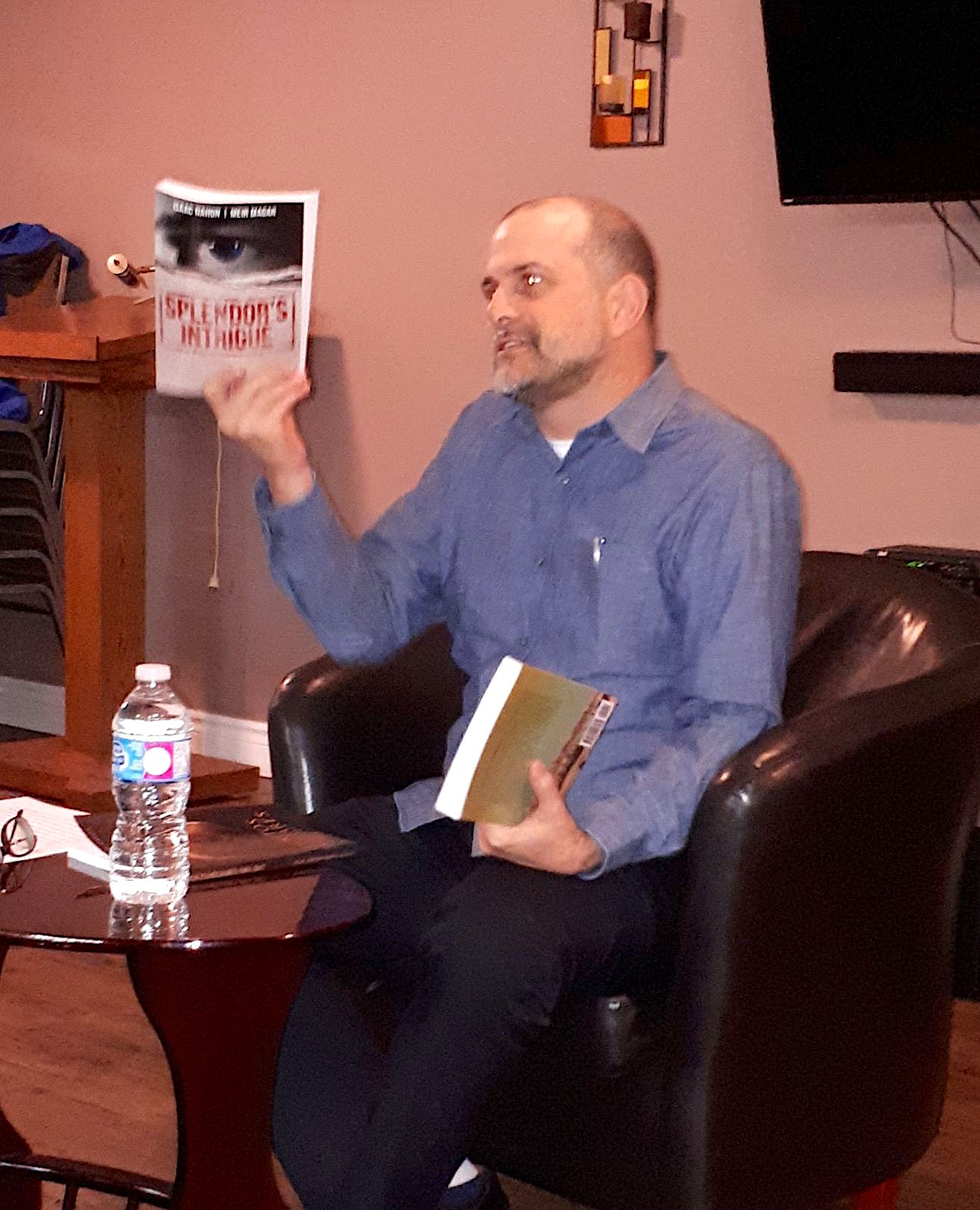
Notes about Splendor's intrigue (English translation of La conjura del esplendor)

Fiction and reality in a very Sephardic novel

Sephardi Association of Ottawa, October 28, 2017
(Motzaé Shabbat)

Shavua Tov, Buenas semanas:

I would like to thank my friends and colleagues from the Sephardi Association of Ottawa, and particularly our president Isabelle Benhamou, for giving me the opportunity to present the English translation of the novel that I co-wrote with Meir Magar, La conjura del esplendor, in English Splendor’s intrigue.

I would also like to thank you all for being here to talk about this very Sephardic novel.

First, I want to briefly discuss the covers of the Spanish and the English versions of the novel, both of them designed by my son Gabriel Nahón. The eye is a common element in both covers, and if you already read the novel, you know that there is this idea that someone, somewhere, has this ability of seeing everything, everywhere and therefore, somewhat a Big Brother who controls things. The main difference between the two covers is the golden hook. In Spanish, it was easy to play with the hook because the word Conjura (Conspiracy or Intrigue) has a “J” in the middle, becoming the glaring hook, a key element in the plot of the novel. Without spoiling the story for those who have not read it yet, this novel has at least three narrative layers, and one of the layers (the novel within the novel) is actually a hook to catch certain “fishes” blinded by the light or the splendour of the story.

What means to write a novel with another person, writing by four hands, as we sometimes do when playing piano? Meir lives in Venezuela, and I live here in Ottawa. Today we have Whatsapp, email, Google, Skype. But even with all this technology, the main challenge of writing a text with another person is not the exchange of information or sharing ideas. The main challenge is how you build a story or various stories (as in the case of this novel) that at the end will have some internal coherence and cohesiveness, and will, hopefully, capture the attention of the reader. 

As everything in life, the novel Splendor’s intrigue has a genesis. The origin of the novel is a research that Meir Magar did about the story of the Nahón family. He did a very comprehensive research, read many documents, consulted several Internet sites. The Nahón’s family story is in many ways the story of the Sephardim expelled from Spain in 1492.  Meir first wrote a paper that he published in the journal of Sephardic Studies Maguén-Escudo in Caracas. But Meir had a lot of information. He called me one day and told me. I have very interesting details about the Sephardim. I think I can write a novel with this. Would you like to write it with me?

I was not sure what was going to result from this experiment. Meir took care of everything that is either historical, old or mythical in Splendor’s intrigue. I focused on the contemporary fiction. The question was how we could connect both narrative streams, the old, historical, and the current fictional events. What could be the link between the saga of the descendants of the great Sephardi poet Yehuda Ha’Levi Abulafia, and the plot of delirious and apocalyptic religious fanatics in this turbulent world?  

The writing process was a truly contrapunctus as we say in music, a contrapunteo as we say in Venezuela. Sometimes the contrapunctus was quite intense: to a historical chapter from Meir, followed another one of current conspiracies, celestial hackers and the almost detective work done by some of the characters in the novel.

But we faced moments where nothing worked and the contrapunctus stopped. At this time, in front of the “white page”, a conversation via Skype with Meir helped to ignite the spark of imagination and to find an exit to the labyrinth that we were building together.

Why did we decide to call the novel Splendor’s intrigue or La conjura del esplendor? My colleague Pierre Lévy told me that the idea of conspiracy or intrigue is associated with the notion of opacity, something that is hidden. Why then make the connection with this notion of light, something that is brilliant, flashy? It’s because at the heart of the intrigue, of the plot, there is an object that causes a glare, an effect of blinding by the excess of light (éblouissement in French). And the story of this glaring object that could seem fantastic, impossible, could be seen as real, truthful in the eyes of some delirious fanatics. And who is weaving this web of intrigues? Someone who knows well the psychology of these fundamentalists who are ready to believe in their own toxic conspiracy theories.

The labyrinth that we built in this novel was carefully set by my co-writer Meir Magar. All the events in the novel before and after the expulsion of the Jews from Spain in 1492 are very well documented. In the notes from the “writer” Haim Abulafia, the doctor from Tel Aviv who descends from the family of Yehuda Ha’Leví Abulafia, that you can find at the end of the novel have the references with the books, the sources, the sites that we consulted. We tell there the story of the Jews from Spain, with its splendorous and not so splendorous moments. But I think the value of this novel, and this is my very subjective opinion, resides in approaching the question of being Sephardi, of being a Sephardic Jew in the current context, and explores, in a fictional but still valid way, how what happened in the past shapes the current geopolitical moment when identities emerge, change, are strengthened (as in the case of the “marrano” or “converso” Segura in the novel), but also how they coexist and enter in conflict.  

And this leads me to my other question: how history, fiction and current events are articulated in this novel? I think the main difference with the history of historians, that should be very rigorous, the historical novel or historical fiction can introduce some nuances, some grey areas that are also important to understand what we are living now. In that sense, I would like to highlight something about the characters of Splendor’s intrigue: they are all very human in their greatness or miseries, in their idealism or in their very basic instincts. And sometimes, those who are portrayed as villains in the media, could also have their heroic side, and vice versa, there are heroes that can become villains. In the labyrinth of the novel we find a cul-de-sac.  What’s the right path towards the exit of this labyrinth? I don’t think we have a clear, definitive answer from the perspective of the historical fiction. And I am wondering if we, Meir and I, found really the right path to escape from the Splendor’s intrigue. I will leave it to the readers to answer this question. Some readers have told us that they feel that the novel continues and are looking forward to read the second part. Let’s see what happens.

Thank you,


Isaac Nahón Serfaty