Mostrando entradas con la etiqueta Irán. Mostrar todas las entradas

domingo, 10 de mayo de 2020

Foucault y la fascinación de la izquierda radical por la República islámica de Irán


“En sus crónicas sobre el Irán revolucionario, el filósofo francés Michel Foucault (1978) observó con entusiasmo la “espiritualización de la política” del movimiento que lideraba el Ayatolá Jomeini”

El artículo completo en El Papel Literario de El Nacional.

lunes, 18 de marzo de 2019

Los tres primeros capítulos de la novela seriada sobre la Venezuela post-apocalíptica

Lápida de la tumba de Menahem Bendelac Z"L en el panteón sefardí
en el Cementerio General del Sur en Caracas, Venezuela

¿Quién me ayuda a escribir una novela?

No le he puesto título todavía, pero ustedes me pueden ayudar también a ponerle el título.
Iré publicando una serie por entregas. Es un experimento que quiero hacer con ustedes. Esto que iré contando es pura ficción, pero sin duda tiene resonancias con la actualidad, especialmente con la actualidad de #Venezuela. Espero que quieran acompañarme en esta aventura.

La foto que ilustra esta nota del blog corresponde a la lápida de Menahem Bendelac Z”L, tío abuelo de mi papá Jacob Nahón Israel Z”L, nacido en Tetuán (Marruecos), que se fue a Venezuela a principios del siglo XX y se instaló en San Fernando de Apure, en los llanos venezolanos. Es su historia la que inspira ésta que comienzo a relatarles.

Aquí van los tres primeros capítulos que he ido publicando en Facebook:

Los otros capítulos los iré publicando en mi cuenta en Facebook.


martes, 29 de mayo de 2018

Gaza e Israel: política, teatro y amnesia


* Ni el portal web de Letras Libres ni El País quisieron publicar este artículo. El editor de Letras Libres me explicó que el texto que escribí se alejaba de la línea  "moderada y cautelosa " que esa publicación mantendría con respecto al conflicto entre Israel y los palestinos. El País dijo que tenía demasiados artículos y que no contaba con espacio para publicar el mío.

Mahmoud al-Zahar, co-fundador de Hamás:
“cuando hablamos de ‘resistencia pacífica’ estamos  engañando al público…
Esto es resistencia pacífica apoyada por una fuerza militar y por agencias de seguridad..."

La política tiene mucho de teatro. Esto no es una novedad, pero ella adquiere un talante espectacular en estos días de redes sociales, periodismo ciudadano y dominio de las imágenes omnipresentes como factor que moldea la opinión pública. Dos eventos que se ubican en polos opuestos, aunque son parte de la misma tragedia sobre la que escribiera el historiador y diplomático Shlomo Ben- Amí,  ilustran bien la explosión dramática de la política. El primero es la presentación que hiciera el primer ministro Benyamín Netanyahu de los documentos nucleares iraníes supuestamente recabados por el Mossad. El otro es la reciente ola de violencia en la frontera entre Gaza e Israel. En ambos casos se ha impuesto una razón estratégica con el fin de crear un efecto de opinión que apuntale agendas políticas. Netanyahu montó su calculada puesta en escena para darle un argumento adicional a Donald Trump con el fin de romper el tratado que Obama había firmado con Irán. Hamás, el movimiento islamista que gobierna la franja de Gaza, convocó a la movilización masiva hacia Israel, en lo que han denominado la “marcha del retorno”, con el fin de poner el tema palestino en la agenda internacional, después que había sido desplazado a un tercer plano por otros asuntos como la guerra en Siria y las tensiones con Irán.

La opinión pública no siempre valora las cosas de la misma manera. Medios de comunicación, periodistas y articulistas han rápidamente reaccionado ante la violencia en la frontera gazatí-israelí, asumiendo como una verdad absoluta el relato que de las protestas ha hecho Hamás, mientras que han sido más escépticos con respecto a lo planteado por Netanyahu sobre las ambiciones nucleares de Irán. Muchos medios han repetido que las movilizaciones de los palestinos en Gaza serían una muestra de “protestas pacíficas” al estilo de las que convocaron en su momento Gandhi en la India o Martin Luther King en los Estados Unidos. Esto lo ha desmentido el propio cofundador de Hamás, Mahmoud al-Zahar, quien ha dicho en una entrevista con Al Yazira que “cuando hablamos de ‘resistencia pacífica’ estamos  engañando al público…Esto es resistencia pacífica apoyada por una fuerza militar y por agencias de seguridad”(pueden ver la entrevista aquí).  Es decir, la movilización masiva “pacífica” de palestinos hacia la frontera con Israel sería la continuación de la guerra por otros medios, no solo para infiltrar el territorio israelí y cometer actos terroristas, sino para ganar una guerra de propaganda en la que lamentablemente muchos habitantes de Gaza, probablemente desesperados ante las difíciles condiciones de vida en la franja, son usados como peones de los islamistas.

Hay, sin embargo, otros factores que influyen en las lecturas que se hacen de los lamentables sucesos en Gaza y de la presentación de Netanyahu, y éstos tienen que ver con la antipatía que suscita Donald Trump. Si la política es teatro, los espectadores juzgan por sus gustos y afinidades. Trump cae mal a muchos periodistas y articulistas por su discurso agresivo, su chocante machismo, sus decisiones impulsivas, los obvios conflictos de intereses entre sus negocios y su papel como presidente y el de su familia en su gobierno, sus posiciones que a veces bordean el racismo, y también, hay que decirlo, por su apoyo incondicional al gobierno de derechas que encabeza Netanyahu en Israel. Estas valoraciones que se hacen de Trump, y de alguna manera del proprio líder israelí, tienden a producir ataques de amnesia selectivos en quienes juzgan las decisiones y acciones de estos gobernantes. Olvidan, por ejemplo, que los líderes de Irán han declarado que su objetivo es borrar a Israel del mapa, o que hace algunos años mandaron a sus agentes hasta Buenos Aires para volar la sede de la organización judía más importante de ese país en un atentado en el que murieron 85 personas, o incluso que el gobierno iraní asumió como política oficial el negacionismo del Holocausto con el fin de legitimar su propio discurso antisemita disfrazado de antisionismo. 

También las antipatías hacen olvidar que Hamás en un documento de 2017, en el que reafirma los principios de su carta de 1988, declara que “el establecimiento de ‘Israel’ (sic) es completamente ilegal y contraviene los inalienables derechos del pueblo palestino y van contra su voluntad y la voluntad de la Ummá (la nación islámica) …”, que  “rechaza cualquier alternativa a la completa y total liberación de Palestina, desde el río (Jordán) hasta el mar (Mediterráneo)”, aunque de forma táctica considera - sin renunciar a su rechazo de lo que llama ‘la entidad sionista’ y sin renunciar a ninguno de los “derechos de los palestinos” - “el establecimiento de un estado palestino soberano e independiente, con Jerusalén como su capital en las fronteras del 4 de junio de 1967 (antes que estallara la Guerra de los Seis Días) …”.

Hamás ha fracasado en mejorar la situación de los palestinos en Gaza. Desde que Israel se retiró de la franja en 2005, el movimiento islamista controla el gobierno del territorio palestino después de cruentos enfrentamientos con la fracción de Al Fatah, que preside la Autoridad Palestina en la Margen Occidental del Jordán. La reconciliación entre los dos grupos palestinos no termina de concretarse, aunque se hayan dado acercamientos promovidos por Egipto. El liderazgo de Hamás vive una crisis que pretende tapar usando, como lo ha hecho antes, a la población civil como escudo contra Israel. Es necesario refrescar la memoria de vez en cuando, para no caer en las trampas de la política como teatro.

domingo, 29 de octubre de 2017

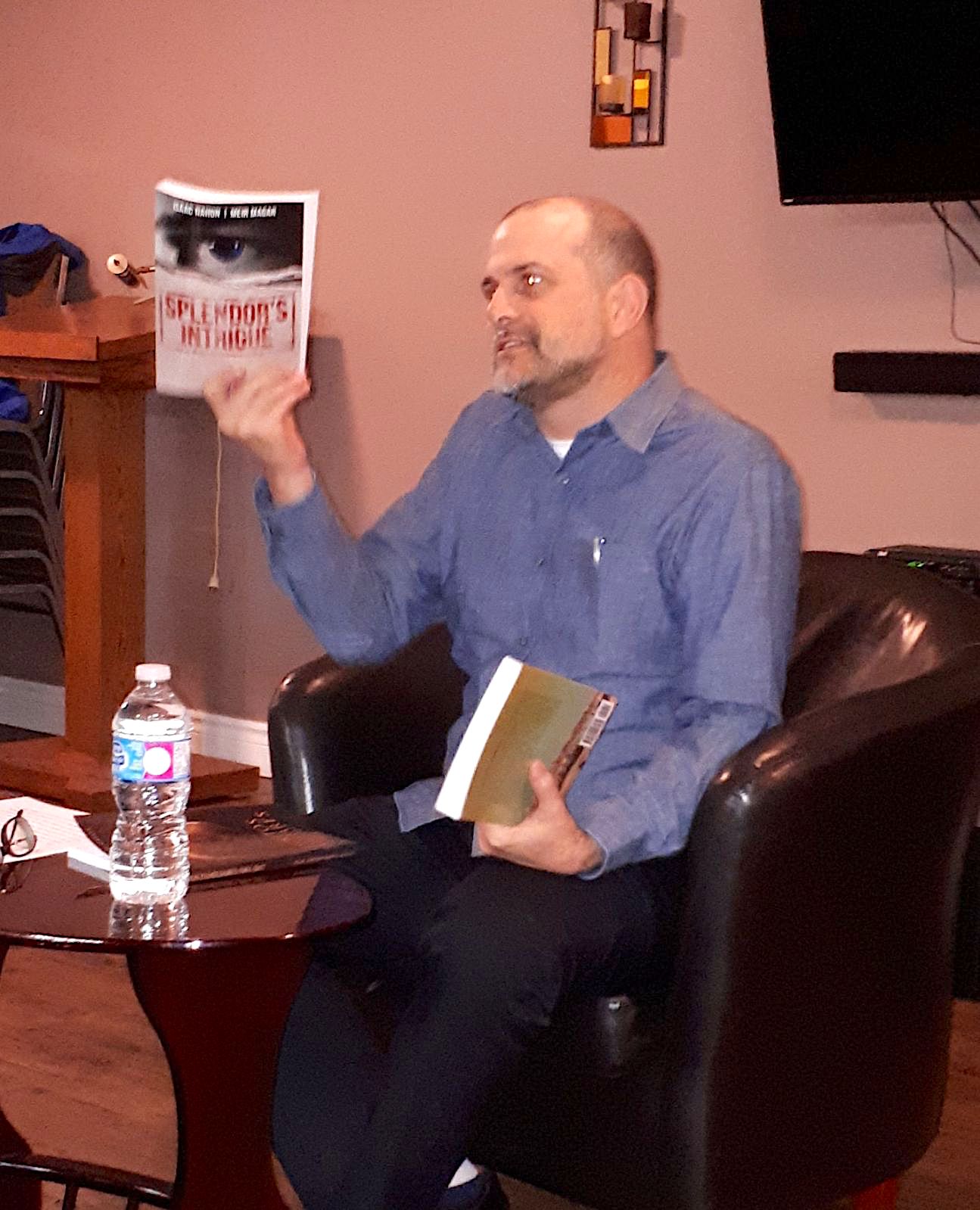
Notes about Splendor's intrigue (English translation of La conjura del esplendor)

Fiction and reality in a very Sephardic novel

Sephardi Association of Ottawa, October 28, 2017
(Motzaé Shabbat)

Shavua Tov, Buenas semanas:

I would like to thank my friends and colleagues from the Sephardi Association of Ottawa, and particularly our president Isabelle Benhamou, for giving me the opportunity to present the English translation of the novel that I co-wrote with Meir Magar, La conjura del esplendor, in English Splendor’s intrigue.

I would also like to thank you all for being here to talk about this very Sephardic novel.

First, I want to briefly discuss the covers of the Spanish and the English versions of the novel, both of them designed by my son Gabriel Nahón. The eye is a common element in both covers, and if you already read the novel, you know that there is this idea that someone, somewhere, has this ability of seeing everything, everywhere and therefore, somewhat a Big Brother who controls things. The main difference between the two covers is the golden hook. In Spanish, it was easy to play with the hook because the word Conjura (Conspiracy or Intrigue) has a “J” in the middle, becoming the glaring hook, a key element in the plot of the novel. Without spoiling the story for those who have not read it yet, this novel has at least three narrative layers, and one of the layers (the novel within the novel) is actually a hook to catch certain “fishes” blinded by the light or the splendour of the story.

What means to write a novel with another person, writing by four hands, as we sometimes do when playing piano? Meir lives in Venezuela, and I live here in Ottawa. Today we have Whatsapp, email, Google, Skype. But even with all this technology, the main challenge of writing a text with another person is not the exchange of information or sharing ideas. The main challenge is how you build a story or various stories (as in the case of this novel) that at the end will have some internal coherence and cohesiveness, and will, hopefully, capture the attention of the reader. 

As everything in life, the novel Splendor’s intrigue has a genesis. The origin of the novel is a research that Meir Magar did about the story of the Nahón family. He did a very comprehensive research, read many documents, consulted several Internet sites. The Nahón’s family story is in many ways the story of the Sephardim expelled from Spain in 1492.  Meir first wrote a paper that he published in the journal of Sephardic Studies Maguén-Escudo in Caracas. But Meir had a lot of information. He called me one day and told me. I have very interesting details about the Sephardim. I think I can write a novel with this. Would you like to write it with me?

I was not sure what was going to result from this experiment. Meir took care of everything that is either historical, old or mythical in Splendor’s intrigue. I focused on the contemporary fiction. The question was how we could connect both narrative streams, the old, historical, and the current fictional events. What could be the link between the saga of the descendants of the great Sephardi poet Yehuda Ha’Levi Abulafia, and the plot of delirious and apocalyptic religious fanatics in this turbulent world?  

The writing process was a truly contrapunctus as we say in music, a contrapunteo as we say in Venezuela. Sometimes the contrapunctus was quite intense: to a historical chapter from Meir, followed another one of current conspiracies, celestial hackers and the almost detective work done by some of the characters in the novel.

But we faced moments where nothing worked and the contrapunctus stopped. At this time, in front of the “white page”, a conversation via Skype with Meir helped to ignite the spark of imagination and to find an exit to the labyrinth that we were building together.

Why did we decide to call the novel Splendor’s intrigue or La conjura del esplendor? My colleague Pierre Lévy told me that the idea of conspiracy or intrigue is associated with the notion of opacity, something that is hidden. Why then make the connection with this notion of light, something that is brilliant, flashy? It’s because at the heart of the intrigue, of the plot, there is an object that causes a glare, an effect of blinding by the excess of light (éblouissement in French). And the story of this glaring object that could seem fantastic, impossible, could be seen as real, truthful in the eyes of some delirious fanatics. And who is weaving this web of intrigues? Someone who knows well the psychology of these fundamentalists who are ready to believe in their own toxic conspiracy theories.

The labyrinth that we built in this novel was carefully set by my co-writer Meir Magar. All the events in the novel before and after the expulsion of the Jews from Spain in 1492 are very well documented. In the notes from the “writer” Haim Abulafia, the doctor from Tel Aviv who descends from the family of Yehuda Ha’Leví Abulafia, that you can find at the end of the novel have the references with the books, the sources, the sites that we consulted. We tell there the story of the Jews from Spain, with its splendorous and not so splendorous moments. But I think the value of this novel, and this is my very subjective opinion, resides in approaching the question of being Sephardi, of being a Sephardic Jew in the current context, and explores, in a fictional but still valid way, how what happened in the past shapes the current geopolitical moment when identities emerge, change, are strengthened (as in the case of the “marrano” or “converso” Segura in the novel), but also how they coexist and enter in conflict.  

And this leads me to my other question: how history, fiction and current events are articulated in this novel? I think the main difference with the history of historians, that should be very rigorous, the historical novel or historical fiction can introduce some nuances, some grey areas that are also important to understand what we are living now. In that sense, I would like to highlight something about the characters of Splendor’s intrigue: they are all very human in their greatness or miseries, in their idealism or in their very basic instincts. And sometimes, those who are portrayed as villains in the media, could also have their heroic side, and vice versa, there are heroes that can become villains. In the labyrinth of the novel we find a cul-de-sac.  What’s the right path towards the exit of this labyrinth? I don’t think we have a clear, definitive answer from the perspective of the historical fiction. And I am wondering if we, Meir and I, found really the right path to escape from the Splendor’s intrigue. I will leave it to the readers to answer this question. Some readers have told us that they feel that the novel continues and are looking forward to read the second part. Let’s see what happens.

Thank you,


Isaac Nahón Serfaty