You can watch the video recording of the Zoom talk I gave at the Sephardi Association of Ottawa about Affirmed and Hidden Identities: from the Inquisition to the Shoah
Mostrando entradas con la etiqueta Sephardi. Mostrar todas las entradas
Mostrando entradas con la etiqueta Sephardi. Mostrar todas las entradas
sábado, 29 de mayo de 2021

domingo, 2 de septiembre de 2018
Pequeña Hermana (Ahot Ketana)
Querida familia, queridos amigos:
Esta es la segunda entrega de una tradición que iniciamos el año pasado mi primo Rafael Encaoua Serfaty y este servidor de presentarles los piyutim que cantamos en Rosh Hashaná los judíos sefardíes. En esta oportunidad se trata del hermoso poema litúrgico Ahot Ketana (Pequeña Hermana) de Rabí Abraham Hazán (Gerona, siglo XIII). La traducción al español es de Rafael. Esta vez contamos con la voz de mi esposa Cheryl Riera. Yo recité el poema e hice el diseño sonoro y la mezcla. Si tienen paciencia, los invito a escuchar la grabación hasta el final para disfrutar una extraña versión en jazz de la melodía del piyut interpretada por Jacques Schwarz-Bart (saxofón) y Gary Dourdan (voz). Que empiece el año con sus bendiciones
תָּחֵל שָׁנָה וּבִרְכוֹתֶיהָ
domingo, 18 de marzo de 2018
Being a Sephardi Moroccan Venezuelan Canadian Jew: A case of multiple identities

Everybody is obsessed with identity these days. People look
deeper to find their roots. They have their DNAs checked by ancestry.com or
geni.com to find out their genetics mix (because we are all the result of a mix
–there is no “racial” purity fortunately – but we – the humanity - seem to come
from the same parents, as shown by a recent study published in Science
journal). There is identity politics and its subdivisions: gender,
religious, language politics. Certainly we, Jews, have been obsessed with our
identity, either from within but mainly from outside, particularly when those
who wanted to destroy us had a supposedly “clear” answer to the question “Who
is a Jew?” I won’t try to answer this question – I prefer to leave it as an
open question -. Instead I propose to explore the multiples dimensions of
identity, and I will try to do so with the case I think I know the better, my
own case as a Sephardi Moroccan Venezuelan Canadian Jew.
The Argentine writer Jorge Luis Borges said in a lecture
about James Joyce and the Irish culture – he was quoting the Norwegian-American
sociologist Thorstein Veblen – that the intellectual pre-eminence of Jews in
modern Europe was mainly due to the fact that the Jews in the Western world
were dealing with a culture that was not theirs, a culture to which they did
not profess any “loyalty” (here I am quoting Borges), a culture that they could
approach without superstitions, and in many occasions, with a revolutionary
aim. Without pretending to answer the
question Who is a Jew, I can say - based on Borges and Veblen’s points of view
– that we are is this double and even ambiguous position in society that allows
us to have a look at the same from inside and from outside, with a certain
detachment, but also with a certain nostalgia or saudade (as the Portuguese say).
I will explore today two dimensions of this multiple Sephardic
Moroccan Venezuelan Canadian Jewish being: the language (or the languages I
should say), and what I call the “painful identity”.
The languages
It always seemed to me that the title of the first volume of
the memoirs of the Literature Nobel Laureate Elias Canetti, The Tongue Set Free (that could be
translated alternately in French as La
langue sauvée), referred to the German, the language in which this
Sephardic Jew born in Bulgaria wrote his books. Canetti himself explains the
title in the first chapter of his memoirs, based on a childhood memory in which
a man, the lover of his nanny, threatened to cut off his tongue. The absolved
tongue (langue in French or lengua in Spanish) represents the
physical organ that the writer "saved" from that man's razor that,
with that intimidating gesture, ensured the child's silence (Tomás Eloy
Martínez preferred to call this book La
lengua salvada or The Saved Tongue/Language). But in the field of
interpretations, we could say that Canetti "saved" and
"acquitted" the German, the language of the Nazi executioners, as a
gesture of reaffirmation and victory. One of his other languages was Ladino
(he also spoke French and English), which he called the "language of the
kitchen" (la lengua de la cocina),
a language that he learned as a child from his mother, a proud Sephardic Jew
who thought that her Spanish origins gave them a certain aristocratic character.
I was born in Tangier, Morocco. My parents were born in
Tetouan, a small city near Tangier. They are the daughter and son of tetaunis, Jews descendants of those
expelled from Spain in 1492. It is probably that my ancestors (Nahon, Serfaty,
Laredo, Israel, Abudarham) came to Tetouan from the town of Naon in Oviedo, and
Granada, and it is also very probably that they arrived in Morocco at the same
time that the moors expelled from Andalusia.
There was an important cultural difference between these two
groups of expelled people, or “megorashim”
as we say in Hebrew. The moors kept
their language (the Arab) and continued to develop a culture and institutions
in their language. But we, the Sephardic
Jews had a particular link with Spain, the Spanish language. Isolated from the
rest of the world, those Jews kept this language as a treasure with a mix of
nostalgia and pride. The romances, a form of poetry born in Spain that we
assimilated and kept in the form of folk songs, express very well this feeling
of nostalgia, of homesick, of the cities, the landscapes, the flavours, the
music of this country that did not like us, a country that meant also
suffering, death and destruction for the Jewish people. This is a strange love
affair, a love affair that has the language as its most precious object. That’s
why my grandmother sung and even today we sing romances like this one: “En la ciudad de Toledo, en la ciudad de
Granada, vivía un mancebo que Diego León se llama …” (in the city of
Toledo, in the city of Granada, used to live a young man called Diego
León).
The Spanish was also a mean to express our religious life.
There is something in the judeo-español,
our particular form of ancient Spanish called Haketía mixed with Hebrew and Arab, that communicates an extra
dimension to the prayers and texts of our tradition. A good example of this is
the Pesach Hagadah. For me is very important that after saying in Aramaic “Ha lahma hanya di ahalu abahatana dearha
demisrayim…”, to recite the judeo-español translation, that is more than a
translation, a text that captures the very essence of Pesach as Zeman Herutenu, the Time of our Liberation.
And I read as my grandfather and my father did every Seder: “Este es el pan de la aflicción que comieron
nuestros padres en tierra de Egipto. Todo el que tenga hambre que venga y
coma…”.
We moved to Venezuela when I was six years old, in 1968. The
Spanish language, the language we cherished, this treasure we carry everywhere
we go, helped us to make the connection with this wonderful and now troubled
country where the Spanish is spoken with the flavour (el sabor) of the people from the Caribbean. In some way, we never
felt like strangers in this new land. As my mother said when she saw for the
first time the Venezuelans in the La Guaira Port: “It seems that we never left
Tangier”. The Mediterranean, the Caribbean, the Moroccans, the Venezuelans,
these mestizos peoples, and the
experience, so common to us in our history of wandering people, of hybrid
cultures, of being a people among the peoples.
But there is a Jewish language that transcends the Ashkenazi
/ Sephardic division, and that communicates something that is uniquely Jewish
beyond the language through which is conveyed, either Hebrew, Yiddish, Ladino,
French or English. There is a scene from Seinfeld that summarizes for me what
could be the "Jewish language" par excellence. Jerry's father, who is
spending a few days in New York, calls a friend in South Florida (where the old
American and Canadian Jews go to retire), who reacts to the unexpected call by
asking with a very Jewish cry: " Who died?". The call was not to
announce the death of anyone, but to ask a favor. But in the Jewish code
"Who died?" says a lot about that way we Jews talk, no matter our
origins and languages.
The Seinfeld scene, which reflects the interaction between
two typically American Jews, and probably Ashkenazi New Yorkers, could have
been perfectly played by two Moroccan or Turkish Jews. The Jewish code, fed by
a series of common imaginaries that make up the Jewish thinking and feeling,
has a certain universality that even overcomes the barriers of time. In some passages
of the Bible and the Talmud, to mention two canonical texts of Judaism, we
already find some passages that could have been written by Woody Allen, the
Marx brothers or Larry David. For example, in an exchange between the sages
around the story of the Tower of Babel collected in the Midrash (legends or
stories that complement the biblical narrative) is told, describing the fact
that God "came down" to see the construction of the tower, the
following: "Rabbi Shimon ben Yochai says: this represents one of the ten
descents mentioned by the Torah (made by the Holy One, Blessed be He, to the Earth).
'That the sons of man had built'. Oh well, and what they would have said, Rabbi
Berechia exclaimed, that they were the children of a donkey or a camel!"
Going back to Borges and Velben, we can say that the Jewish
language, embedded in the languages of our many diasporas, has this duality of
memory and irony, and if you want cynicism, that connects us with the past and also
provides us with the necessary critical look about the world and the human
beings.
Painful identity
Another universal Jewish experience is what I call the
“painful identity.” Identity is not purely positive affirmation, it is also
conflict or “déchirement” as we say
in French. The expression “painful identity” came to my mind when Daniel Shoer
Roth, now a journalist in Miami's The New Herald, told me a very revealing
anecdote of the twists and turns of Jewishness. A few years ago, Daniel wrote a
book about five great Jewish-Venezuelan journalists: Gustavo Arnstein, Alicia
Freilich, Paulina Gamus, Carlos Guerón and Sofía Imber. One day a renowned
Venezuelan editor and columnist, whose name I won’t disclose, complained to
Daniel because he had not included him in the book. Daniel answered with surprise:
"I never thought you would consider yourself as a Jew." But identity
is a changing and deeply emotional thing. Who knows if this editor and
columnist, who at another time in his life chose to avoid identification with
the Jews, over the years felt a need to express his Jewishness.
As you know, Spain passed a law two years ago to give the
Spanish citizenship to the descendants of the Jews expelled in 1492. I don’t know
how many Sephardic Jews have applied for the citizenship, but I do know that many
Venezuelans who were barely aware of their Jewish origins have applied to
become Spaniards. Individuals bearing the names Maduro (yes, Maduro as the
current Venezuelan president), Capriles (as the leader of Venezuelan democratic
opposition), De Sola, Ricardo, Mendoza, Benatuil, Curiel, Nunes, from families
that long time ago assimilated and became Catholics, remembered suddenly that
their ancestors came to Venezuela via Curaçao, from where they arrived as
Spanish-Portuguese Dutch Jews, the same families that in the XVII Century
arrived to New Amsterdam (today New York) and founded the Congregation Shearith
Israel, the Spanish-Portuguese synagogue, in 1654. And these Venezuelans found suddenly
their Sephardic connection to obtain the Spanish citizenship to flee the hell
that is Venezuela today, the country with the highest inflation rate in the
world (14,000 per cent projected for this year, according to the FMI), crime
out of control, and scarcity of medications and food.
Another case of “painful identity” that I documented in an
article I co-wrote with my friend Néstor Garrido, is the one of Venezuelans
who converted to Judaism and decided to move to Israel amidst this horrible
crisis. As in many other countries in Latin America (Peru, Colombia, Bolivia),
former Evangelical Venezuelans converted to Judaism and decided to make aliah, but they have faced many hurdles,
some internal (there is no Israeli consulate in Venezuela because president
Hugo Chávez broke diplomatic relations with Israel) and some external (they
also faced some problems associated with the politics of conversion in Israel).
The Jewish community in Venezuela is facing something that we
have seen in other once prosperous and vibrant communities in Morocco, Egypt,
Lebanon, Poland or Germany. They are in the process of decline in the middle of
a terrible crisis that is affecting all Venezuelans without distinction of
religion or origin. I won’t say that the community is facing antisemitism, but
the anti-Israeli politics of the current regime has certainly introduced the
“Jewish question” into the public sphere, in a country that welcome the Jews
after the war and where Jewish institutions (schools, synagogues, social and
sport centers, museums) flourished. I would like to mention specially the
important role that the Centro de
Estudios Sefardíes de Caracas (the Center of Sephardic Studies in Caracas)
has played in the diffusion of our Sephardic heritage through conferences,
concerts, recordings, books and the journal Maguén-Escudo.
But I don’t want to finish this presentation on a negative
note. I want to highlight many of the positive things of the Venezuelan Jewish
community, its contributions to science and arts, and its achievements in
promoting and enriching our Sephardic legacy. For example, the only Venezuelan
Nobel Prize of Medicine is the Sephardi Baruch Benacerraf, whose family
migrated to Venezuela from Tetouan, Morocco. Or the case of the filmmaker
Margot Benacerraf who won the Critics Prize at the Festival of Cannes for her
movie Araya. Or the wonderful novel
by Isaac Chocrón, Rómpase en caso de
incendio (Break in case of fire), where a Venezuelan Jew returns to Morocco
looking for his multiple identities; the recordings of Esther Rofé where she
sings the wonderful Spanish romances that we cherished so much; the liturgical
recordings of Moisés Serfaty; the translation into modern Spanish of the
Haftaroth by Rafael Encaoua and David Suisa; the Letter (La carta) that Lucy Garzón wrote in Haketía, a wonderful piece of Jewish humor; the Sephardic Week
Festival organized by Moisés Garzón, Jacob Carciente, Amram Cohén, Abraham
Botbol, Abraham Levy, Isaac Benarroch, Aquiba Benarroch Lasry, Miriam Harrar,
Priscilla Abecasis, Alberto Moryusef, among many others. I can go on and on
mentioning many other accomplishments. I just want to thank Limmud Ottawa for
giving the opportunity to talk about this community that is facing today many
challenges, but is always fighting to keep alive nuestro corazón judío,
our Jewish heart. Gracias.
*Talk presented at Limmud Ottawa on March 18, 2018.
domingo, 29 de octubre de 2017
Notes about Splendor's intrigue (English translation of La conjura del esplendor)
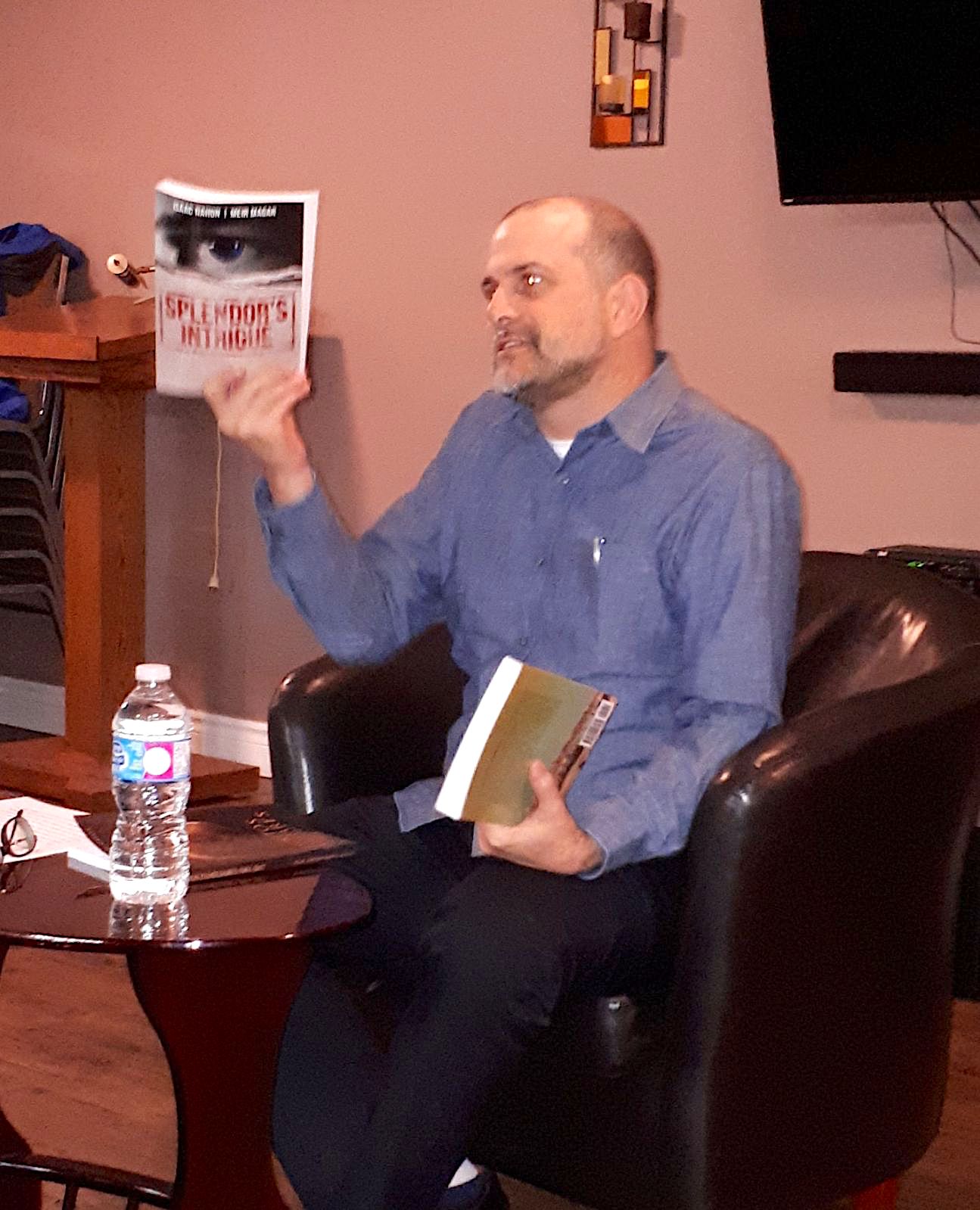 |
| Fiction and reality in a very Sephardic novel |
Sephardi Association of Ottawa, October 28, 2017 (Motzaé Shabbat)
Shavua Tov, Buenas semanas:
I would like to thank my
friends and colleagues from the Sephardi Association of Ottawa, and
particularly our president Isabelle Benhamou, for giving me the opportunity to
present the English translation of the novel that I co-wrote with Meir Magar, La conjura del esplendor, in English Splendor’s intrigue.
I would also like to thank you
all for being here to talk about this very Sephardic novel.
First, I want to briefly
discuss the covers of the Spanish and the English versions of the novel, both
of them designed by my son Gabriel Nahón. The eye is a common element in both
covers, and if you already read the novel, you know that there is this idea
that someone, somewhere, has this ability of seeing everything, everywhere and
therefore, somewhat a Big Brother who controls things. The main difference
between the two covers is the golden hook. In Spanish, it was easy to play with
the hook because the word Conjura (Conspiracy or Intrigue) has a “J” in the
middle, becoming the glaring hook, a key element in the plot of the novel.
Without spoiling the story for those who have not read it yet, this novel has
at least three narrative layers, and one of the layers (the novel within the novel)
is actually a hook to catch certain “fishes” blinded by the light or the splendour
of the story.
What means to write a novel
with another person, writing by four hands, as we sometimes do when playing
piano? Meir lives in Venezuela, and I live here in Ottawa. Today we have
Whatsapp, email, Google, Skype. But even with all this technology, the main
challenge of writing a text with another person is not the exchange of
information or sharing ideas. The main challenge is how you build a story or
various stories (as in the case of this novel) that at the end will have some
internal coherence and cohesiveness, and will, hopefully, capture the attention
of the reader.
As everything in life, the
novel Splendor’s intrigue has a genesis. The origin of the novel is a research
that Meir Magar did about the story of the Nahón family. He did a very
comprehensive research, read many documents, consulted several Internet sites.
The Nahón’s family story is in many ways the story of the Sephardim expelled
from Spain in 1492. Meir first wrote a
paper that he published in the journal of Sephardic Studies Maguén-Escudo in Caracas. But Meir had a
lot of information. He called me one day and told me. I have very interesting
details about the Sephardim. I think I can write a novel with this. Would you
like to write it with me?
I was not sure what was going
to result from this experiment. Meir took care of everything that is either
historical, old or mythical in Splendor’s intrigue. I focused on the
contemporary fiction. The question was how we could connect both narrative
streams, the old, historical, and the current fictional events. What could be
the link between the saga of the descendants of the great Sephardi poet Yehuda
Ha’Levi Abulafia, and the plot of delirious and apocalyptic religious fanatics
in this turbulent world?
The writing process was a
truly contrapunctus as we say in
music, a contrapunteo as we say in
Venezuela. Sometimes the contrapunctus was
quite intense: to a historical chapter from Meir, followed another one of
current conspiracies, celestial hackers and the almost detective work done by
some of the characters in the novel.
But we faced moments where
nothing worked and the contrapunctus
stopped. At this time, in front of the “white page”, a conversation via Skype
with Meir helped to ignite the spark of imagination and to find an exit to the
labyrinth that we were building together.
Why did we decide to call the
novel Splendor’s intrigue or La conjura del esplendor? My colleague Pierre Lévy
told me that the idea of conspiracy or intrigue is associated with the notion
of opacity, something that is hidden. Why then make the connection with this
notion of light, something that is brilliant, flashy? It’s because at the heart
of the intrigue, of the plot, there is an object that causes a glare, an effect
of blinding by the excess of light (éblouissement
in French). And the story of this glaring object that could seem fantastic,
impossible, could be seen as real, truthful in the eyes of some delirious
fanatics. And who is weaving this web of intrigues? Someone who knows well the
psychology of these fundamentalists who are ready to believe in their own toxic
conspiracy theories.
The labyrinth that we built in
this novel was carefully set by my co-writer Meir Magar. All the events in the
novel before and after the expulsion of the Jews from Spain in 1492 are very well
documented. In the notes from the “writer” Haim Abulafia, the doctor from Tel
Aviv who descends from the family of Yehuda Ha’Leví Abulafia, that you can find
at the end of the novel have the references with the books, the sources, the
sites that we consulted. We tell there the story of the Jews from Spain, with
its splendorous and not so splendorous moments. But I think the value of this
novel, and this is my very subjective opinion, resides in approaching the
question of being Sephardi, of being a Sephardic Jew in the current context,
and explores, in a fictional but still valid way, how what happened in the past
shapes the current geopolitical moment when identities emerge, change, are
strengthened (as in the case of the “marrano” or “converso” Segura in the
novel), but also how they coexist and enter in conflict.
And this leads me to my other
question: how history, fiction and current events are articulated in this
novel? I think the main difference with the history of historians, that should
be very rigorous, the historical novel or historical fiction can introduce some
nuances, some grey areas that are also important to understand what we are
living now. In that sense, I would like to highlight something about the
characters of Splendor’s intrigue: they are all very human in their greatness
or miseries, in their idealism or in their very basic instincts. And sometimes,
those who are portrayed as villains in the media, could also have their heroic
side, and vice versa, there are heroes that can become villains. In the
labyrinth of the novel we find a cul-de-sac. What’s the right path towards the exit of
this labyrinth? I don’t think we have a clear, definitive answer from the
perspective of the historical fiction. And I am wondering if we, Meir and I,
found really the right path to escape from the Splendor’s intrigue. I will
leave it to the readers to answer this question. Some readers have told us that
they feel that the novel continues and are looking forward to read the second
part. Let’s see what happens.
Thank you,
Isaac Nahón Serfaty
Suscribirse a:
Entradas (Atom)